The Distinguished Lecturer Series (DLS) of CRC 1665 regularly brings together researchers from different disciplines to engage in critical dialogue on a wide range of topics covered by the umbrella term „Sexdiversity“. On 15 January 2026, the iRTG of the CRC 1665 welcomed Stefan Hirschauer, Professor at the Johannes Gutenberg University of Mainz and Speaker of the CRC 1482 “Human Differentiation”. He gave a public lecture with the title “Genders in dissolution? Sex & gender in historical change”. The lecture took place at the Center for Brain, Behavior and Metabolism (CBBM) of the University of Lübeck.
In his talk, Hirschauer approached gender differentiation as a historically and culturally variable form of human categorization. Rather than treating gender as a fixed biological constant, he emphasized that societies differ in the number and structure of gender categories, the degree to which they are organized in binary terms, and the extent to which they are linked to bodily phenomena. What appears as “natural” or “biological fact” today, he argued, is the outcome of specific historical developments and institutional practices.
Hirschauer, who is an expert in sociology with a focus on Gender Studies, human differentiation as well as sociology of the body, understands gender as one form of human classification based on bodily differences that are culturally and historically framed as the essence of sex/gender. These bodily differences in form of the phenotype of our urogenital tracts ground our understanding of sex/gender, even though these differences are invisible in our everyday life. Therefore, binary-stabilizing codes and symbols – e.g. colors such as pink/blue, dress/trousers; long/short hair and so on – have been established, which Hirschauer understands as a secondary coding to portray one’s sex/gender. This portray of sex/gender is the result of a socially construction that is culturally and historically framed by our social structure, that Hirschauer parts in three elements:
1) Segregation as the form of the institutionalized display of sex/gender; 2) the genderisation of the division of labor; and 3) relationship types that are either androphilic/gynophilic i.e. equal/unequal.
A central point of the lecture was that scientific investigations into sex are embedded in classificatory frameworks that shape how classifications are perceived and interpreted. The socially entrenched yet scientifically outdated assumption of a stable male/female binary has become a long-standing practice of social differentiation, even though a strict binary model of sex is no longer considered state of the art in biomedicine.
The famous study Making sex of Thomas Laqueur from 1992 strengthened the argument that contemporary research in natural sciences on sex cannot be understood independently of the history of gender as a social and epistemic category, which Hirschauer then explained on the basis of, the medical discovery of the so called ‘hermaphrodites’, as well as on the shift to dual sex/gender through the medical “discovery” of the clitoris.
Since the 18th century, reproductive organs have been understood as the difference that explains the binarization of gender, which has been the legitimization of assigning ‘hermaphrodites’ – that we will further address as intersex* – a ‘true’ gender based on body markers that have changed over time. While intersex* people were understood as an obstacle to the binary system of gender, their ‘actual’ gender had to be deciphered so the distinction between males and females wasn’t challenged by the existence of bodies that were understood as merged genders. Hirschauer understands the restriction of bodies as a new political requirement, not only as a colonial practice but a justification for subordination to maintain male hegemony.
Hirschauer understands the restriction of bodies as a new political requirement, not only as a colonial practice but a justification for subordination to maintain male hegemony.
Hirschauer encouraged a reflexive approach to scientific categories, highlighting the importance of critically examining how distinctions are socially and scientifically produced and maintained. The lecture was followed by a lively discussion during which participants reflected on the implications of this perspective for interdisciplinary research within CRC 1665. The discussion connected to Hirschauer’s last argument of the current dissolution of gender differences. Hirschauer claimed that as sociocultural factors increase, gender distinction became less relevant. Specifically, the feminist discourse led to a growth of standards that strengthened the indifference of gender, Hirschauer postulated. Both feminist perspectives and Hirschauer’s conceptualization of trans* required critical negotiation, particularly because he characterized trans* as a social predicament produced by the internalization of normative social expectations. While a critique of the continued maintenance of the binary was broadly shared, some discussants found the claim that contemporary gender discourses simply flatten roles or devolve into confessionalism to be overly reductive.
The discussion also focused on how gender categories are applied across different disciplines, how they become institutionalized, and how researchers can examine them without perpetuating them. In the subsequent plenary session, leading to an open and constructive exchange among all participants. The interdisciplinary composition of the seminar enriched the debate and highlighted the diversity of methodological and conceptual approaches within the CRC 1665.
On Friday, the doctoral seminar at the Institute for History of Medicine and Science Studies (IMGWF) continued with an engaging session. Following a brief introduction of the speaker and opening remarks, participants took part in structured group discussions guided by key questions derived from the lecture. The small-group format offered an opportunity to relate the theoretical arguments directly to their own research projects, fostering both critical reflection and collaborative exchange. The seminar was prepared and organized by PhD candidates Carolina Gómez and Lena:Emil Kramheller.
Stefan Hirschauer with organizers Carolina Gómez and Lena:Emil Kramheller
Although the evening lecture the previous day was held in German rather than English, which prevented several PhD students from participating, the event was nevertheless well attended.
In his concluding remarks, Hirschauer invited participants to critically reflect on the terminology used in research on sex diversity and to remain attentive to the processes through which distinctions are continuously produced.
Group photo of all iRTG DLS participants
Overall, the DLS offered a focused and stimulating contribution to ongoing discussions on gender and human differentiation. We thank Professor Stefan Hirschauer and all participants for an engaged and thoughtful exchange that once again demonstrated the value of interdisciplinary dialogue within the CRC 1665.
What do fly-intestines, artificial blood vessels, and X-chromosome inactivation have in common? That’s right, sex differences!
These and many other topics were discussed at the 2026 EMBO/EMBL (European Molecular Biology Organization/ European Molecular Biology Laboratory) Symposium “Sex Differences in Health and Disease” in Heidelberg, Germany. CRC 1665 researchers Nadine Hornig, Prathiksha Ramesh, and I, Katharina Dörner, attended four days full of talks, discussions, and fun group activities at the EMBL Advanced Training Centre.
In diesem Blogbeitrag möchten wir auf ein weiteres Problem aufmerksam machen: epistemische Ungerechtigkeit gegenüber trans* und nichtbinären Personen. Der Begriff bezeichnet Formen von Ungerechtigkeit, die Menschen in ihrer Eigenschaft als Wissende betreffen. Sie entstehen, wenn Personen aufgrund struktureller Machtverhältnisse darin benachteiligt werden, ihre Erfahrungen zu verstehen, zu beschreiben und anderen mitzuteilen (Fricker, 2007). Wir diskutieren diese Problematik am Beispiel der Detransition.
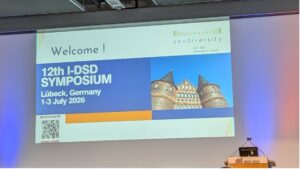
For three days Lübeck became the meeting pot for experts discussing the developments, challenges and aims in research of differences of sex development (DSD). With a variety of participants from five continents, the symposium positioned itself at the interface of research, medicine and psychosocial crosstalk. It brought a new focus to the current scientific perspective, with implications from the latest political decisions in sex testing in elite sports.
The first day featured a lecture by Julia M. Schulze-Hentrich, Professor of Genetics and Epigenetics at Saarland University. Alongside our CRC1665 group, colleagues from neurogenetics also joined the presentation, adding welcome expertise to the room. The paper “Sex and Gender Differences in the Molecular Etiology of Parkinson’s Disease”, which she co-authored, had been shared with the doctoral students beforehand, and to make it accessible across disciplines we also prepared a glossary of key terms.