The CRC 1665 Distinguished Lecture Series (DLS) provides a platform for interdisciplinary dialogue between PhD researchers from the natural and social sciences and internationally renowned guest speakers. On 7–8 May 2028, Julia Schulze-Hentrich presented her research on gender differences in Parkinson’s disease and provided insights into her work in this field.
DLS Lecture: Sex and Gender Differences in the Molecular Etiology of Parkinson’s Disease
The first day featured a lecture by Julia M. Schulze-Hentrich, Professor of Genetics and Epigenetics at Saarland University. Alongside our CRC1665 group, colleagues from neurogenetics also joined the presentation, adding welcome expertise to the room. The paper “Sex and Gender Differences in the Molecular Etiology of Parkinson’s Disease”, which she co-authored, had been shared with the doctoral students beforehand, and to make it accessible across disciplines we also prepared a glossary of key terms.
In her talk, Schulze-Hentrich approached Parkinson’s sex differences as a geneticist and epigeneticist, arguing they stem not from a black-and-white divide between men and women but from many small, cell-type-specific changes that accumulate over a lifetime. She walked the audience from the genome itself- the gene-rich X versus the small Y, and why the textbook SRY/testosterone story is too simple- to epigenetics, where sex-biased signatures are written and stored across the autosomes, not just the sex chromosomes, illustrated by X-chromosome inactivation and calico cats. Turning to Parkinson’s, she stressed that the disease is highly multifactorial, with known genetic variants explaining only 15–20% of cases and age and exposures such as pesticides also at play, so its clinical sex differences can only be understood by studying gene–environment interactions separately in each sex. She closed with three studies from her group- a mouse model where environmental enrichment delayed the disease phenotype, a blood-methylation study whose signals appeared only once the data were split by sex, and a single-nucleus brain dataset showing that sex differences convene within cell types rather than their proportions.
Full video recording of the lecture: https://sfb1665blog.de/new-video-available-julia-schulze-hentrich-on-sex-differences-in-parkinsons-disease/
DLS Seminar on Moving Beyond a Binary Model of Sex and Gender
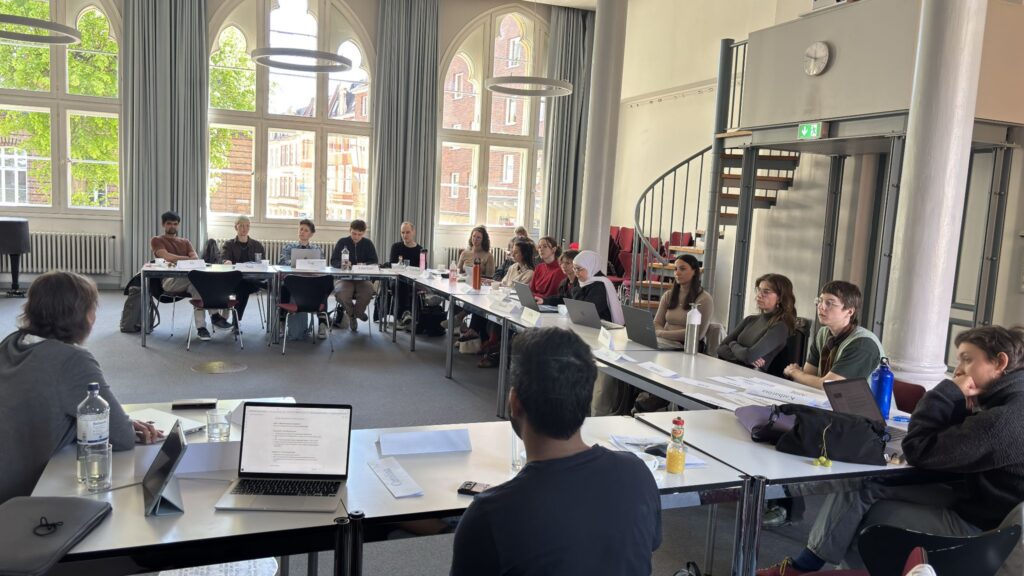
The following morning the doctoral researchers gathered from 10am to 1pm. The group was divided into three smaller discussion groups, each tackling two of the four prepared questions: whether gender norms like pesticide use or smoking modulate biological PD risk and what that does to the binary model of sex; what the incomplete and context-dependent neuroprotection of estrogen tells us about using hormones as explanatory variables; whether the paper’s careful terminological distinction between sex and gender actually changes anything in practice given that the studies it draws on remain binary; and whether the practical solutions proposed for female underrepresentation in PD research address the real problem or merely its symptoms. The first round of discussion happened within the small groups, and the second round brought everyone together for an open discussion where threads from different groups could cross-pollinate and be challenged more broadly.
What really set this workshop apart was the speaker’s engagement. Julia Schulze-Hentrich did not sit back, she moved between every group during the discussions, she listened carefully and engaged directly with participants ideas, creating an atmosphere of genuine intellectual exchange.
This was partly because the topic is directly relevant to her own ongoing work – she is joining a project where questions of sex and gender will be central. So, she was genuinely curious about how PhD students from different disciplinary backgrounds think about incorporating sex and gender into research.
Fruitful Discussion on Collaborative Thinking
Rather than sharp disagreement between natural and social science students, the discussions were characterised by genuine collaborative thinking across disciplines. Feedback from participants supported this observation, with the highest ratings given to the workshop’s ability to encourage meaningful discussion, integrate perspectives from different disciplines, and create an atmosphere in which participants felt comfortable engaging in the conversation. One of the liveliest discussions centred on pesticide exposure and gender norms. An initial instinct in the room was to accept the paper’s framing that pesticide exposure simply follows gendered occupational patterns- men spray pesticides, men get more PD. But students pushed further, noting that this assumption does not hold universally.
In certain populations in Japan, for example, the pattern shifts- women make up a larger share of agricultural workers, and the expected male predominance in PD prevalence does not appear in the same way. This prompted a broader conversation about whether gender norms impose a particular exposure pattern, or whether the relationship between social structure and biological risk is more fluid and context-dependent than any single framework can capture.
The question of the initial paper’s distinction between sex and gender also sparked lively discussion. Participants noted the tension between the authors careful terminology and the binary male/female data on which the analysis is based, raising questions about the limits of terminological precision when the underlying data remain binary. While participants acknowledged the value of remote assessments and at-home sampling, many argued that such measures address only part of the problem. The discussion quickly broadened to structural questions of who designs the studies, who sets funding priorities, and whose experiences are reflected in the tools used to measure symptoms and outcomes.
All in all, organising a DLS session around a paper this interdisciplinary is extremely thought provoking, the questions have to work for people with very different scientific vocabularies and assumptions. The glossary preparation proved its worth, and the two-round discussion format gave students both the intimacy of small group conversation and the broader perspective of whole-room debate. Thanks to everyone who came, participated, and engaged so thoughtfully. And a particular thanks to Julia for bringing such genuine curiosity and openness to the conversation, it made a real difference to the day.
Prathiksha Ramesh & Sudharsan Agas Chandra Prakash
Copyright Images: Prathiksha Ramesh