Next Distinguished Lecture on NeuroGenderings 13. February 2025

We are honored to announce the following Distinguished Lecture Series (DLS) with Prof. Sigrid Schmitz. Her lecture on NeuroGenderings: Approaches for a Sex/Gender informed Brain Research takes place on Thursday, February 13rd (16:00-18:00) at IMGWF in Lübeck and via Webex. 

For the 4th installment of our Distinguished Lecture Series, we are pleased to welcome Sigrid Schmitz, Professor for Gender Studies at the University of Vienna and for Gender and Science at the Humboldt-University of Berlin. Sigrid Schmitz, Dr. habil. currently chairs the project Gendering MINT didaktisch-digital at the Center for transdisciplinary Gender Studies of Humboldt University of Berlin, where she develops Open Educational Resources to transfer knowledge about gender aspects into STEM disciplines. With a PhD and a venia legendi in biology, her research in Feminist Science Technology Studies focuses on gender & brain, on temporary neurocultures, body discourses, and feminist epistemologies. As founding member of the international NeuroGenderings networkSigrid Schmitz edited Gendered NeuroCultures. Feminist and Queer Perspectives on Current Brains Discourses (Zaglossus: Vienna, 2014, together with Grit Höppner). 

Abstract: 

The brain is increasingly conceived as an open biological system developing in mutual interchange with experiences (brain plasticity). Such embodying of the social contests the nature-nurture dichotomy as well as binary sex differences, and, instead, highlights the sex/gender development of brain-behaviour relations. In the transdisciplinary NeuroGenderings network, scholars from neurosciences, gender/queer and feminist science technology studies develop conceptual approaches to analyze the entangled biological, social, and cultural variables that constitute sexed/gendered brains whilst acknowledging their diversity. In her talk, Sigrid Schmitz will outline the bio-socio-cultural approaches of NeuroGenderings, discuss their potentials for a sex/gender informed brain research, but also highlight the challenges, when it comes to specify, select, and negotiate the operationalized variables for empirical research.

For further information and Webex-Link please refer to the attached flyer and our website.

Online-attendance via Webex: Link to the Meeting 

Programm flyer for download: DLS 13.2.2025 Schmitz

The organization team at the iRTG.

Teilen:

Schreibe einen Kommentar

Deine E-Mail-Adresse wird nicht veröffentlicht. Erforderliche Felder sind mit * markiert

Mehr Posts

„The biggest barrier is finding someone that respects me“: Zur Diskriminierung von nicht-binären Personen durch die psychologische Gesundheitsversorgung

Für ihre Bachelorarbeit im Studiengang Psychologie an der Universität zu Lübeck hat Carlotta Behre einen systematischen Review zur Diskriminierung von nicht-binären Personen in der psychologischen Gesundheitsversorgung verfasst. Ende Juli 2026 hat sie die Abschlussarbeit unter dem Titel „Diskriminierung von nicht-binären Personen in der psychologischen Gesundheitsversorgung – Ein systematischer Review“ eingereicht. Dieser Beitrag gibt einen Überblick über ihre zentralen Fragestellungen und Ergebnisse.

At a Glance: Sex Differences in Health and Disease – Highlights from the EMBO/EMBL Symposium 2026

What do fly-intestines, artificial blood vessels, and X-chromosome inactivation have in common? That’s right, sex differences!
These and many other topics were discussed at the 2026 EMBO/EMBL (European Molecular Biology Organization/ European Molecular Biology Laboratory) Symposium “Sex Differences in Health and Disease” in Heidelberg, Germany. CRC 1665 researchers Nadine Hornig, Prathiksha Ramesh, and I, Katharina Dörner, attended four days full of talks, discussions, and fun group activities at the EMBL Advanced Training Centre.

By Nadav Spiegelman

Epistemische Ungerechtigkeit in der Gesundheitsversorgung von trans* und nichtbinären Personen: Eine Analyse von Vorstellungen von Detransition im medizinischen und gesellschaftlichen Diskurs

In diesem Blogbeitrag möchten wir auf ein weiteres Problem aufmerksam machen: epistemische Ungerechtigkeit gegenüber trans* und nichtbinären Personen. Der Begriff bezeichnet Formen von Ungerechtigkeit, die Menschen in ihrer Eigenschaft als Wissende betreffen. Sie entstehen, wenn Personen aufgrund struktureller Machtverhältnisse darin benachteiligt werden, ihre Erfahrungen zu verstehen, zu beschreiben und anderen mitzuteilen (Fricker, 2007). Wir diskutieren diese Problematik am Beispiel der Detransition.

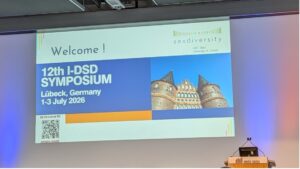
Connecting science across continents: Highlights of the 12th I-DSD congress

For three days Lübeck became the meeting pot for experts discussing the developments, challenges and aims in research of differences of sex development (DSD). With a variety of participants from five continents, the symposium positioned itself at the interface of research, medicine and psychosocial crosstalk. It brought a new focus to the current scientific perspective, with implications from the latest political decisions in sex testing in elite sports.

Nach oben scrollen