When a baby is born with genital anatomy that does not fit typical expectations for “male” or “female”, families are often told very little about why this happened. Even after extensive genetic testing, most families never receive a clear medical answer or an explanation of the underlying molecular cause. This experience, sometimes called the “diagnostic odyssey”, is the everyday reality for most people living with a so-called Difference of Sex Development (DSD) or intersex variation.
In our research within the Collaborative Research Centre CRC 1665 “Sexdiversity” at the University of Lübeck, we investigate exactly this problem: why do so many DSD cases remain genetically unexplained, and how can we use new technologies and develop new approaches to change that? This post explains what DSD is, why current genetic testing so often comes up empty, and why basic research is essential to close this gap, and what our own project M04 has contributed so far.
What are Differences of Sex Development?
Differences of Sex Development, or DSD, is an umbrella term for a wide range of congenital conditions in which chromosomal sex, gonadal sex (the type of gonads a person develops – testes or ovaries), and/or the anatomical appearance of the genitals cannot be uniquely assigned to one sex. DSD is not one single diagnosis but dozens of distinct underlying conditions, ranging from differences in chromosomes (such as atypical numbers of X and Y chromosomes) to specific single-gene variants that interfere with the development of the gonads, with hormone production and hormone signalling.
Some forms of DSD are diagnosed at birth because of visibly atypical genitalia; others are only discovered later, for example, during puberty or when someone seeks infertility treatment. Many people with DSD lead healthy lives once appropriately diagnosed and supported, but an accurate diagnosis matters enormously. It can guide decisions about hormone therapy, surgery, gender assignment, and psychological support. Additionally, it can also flag increased risks for conditions such as gonadal tumours, adrenal insufficiency, heart and kidney anomalies, or even other very severe conditions that sometimes accompany specific genetic causes (Hiort et al., 2019).
The Biology behind Sex Determination: more than a single Switch
For decades, textbooks explained the start of male development in a misleadingly simple way: the SRY gene on the Y chromosome acts like an “on switch”, and it triggers the whole cascade that eventually builds testes. If you have the SRY gene, you become male; if you don’t, you become female. This is often referred to as the classical “master switch” model. On the other hand, two X chromosomes and the lack of the Y chromosome would lead to ovarian development and a female appearance. However, current empirical evidence challenges this older model.
Modern developmental biology tells a much more nuanced story. Early in embryonic development, both potential future gonads start out as an unspecified, “bipotential” tissue that could become either testes or ovaries. Two opposing genetic programmes – a testis-promoting programme and an ovary-promoting programme – actively suppress each other in a kind of tug-of-war during a very narrow window of development. Which programme “wins” determines gonadal fate. Since this is a dosage-sensitive balance rather than a strict binary switch, relatively subtle disturbances – not just complete loss of a gene – can be enough to tip the outcome toward the other pathway.
In mouse models, simply delaying or accelerating the activity of the SRY gene by a small amount is sufficient to reverse an animal’s gonadal sex entirely. The presence of the SRY gene is therefore not the sole determining factor. The timing of its main activity can also play a crucial role in determining whether the developing gonad follows the testicular or ovarian developmental pathway (Capel, 2017). Further, the male or testis-development pathway is not triggered by a simple “switch”. Several signalling genes such as SOX9 initiate testis development. Deleting an enhancer region close to the gene SOX9, causes reversed sex development in mice. Equivalent variants have been found in human patients as well (Croft et al., 2018).
Moreover, the process of embryonic gonadal development is also unusually hard to study directly (Garcia-Alonso et al., 2022). It plays out in a tiny amount of tissue, deep inside the embryo, during the first trimester of pregnancy – a developmental window inaccessible for direct experimentation. Also, the gonad development can only partially be mirrored by animal models as the regulatory details of sex determination differ substantially between mice and humans (Brito et al., 2025).
This changes how we think and research the genetics of DSD or intersex variations. If gonadal fate depends on a finely balanced network of many genes rather than a handful of single master switches, then the genetic causes of DSD should also be far more diverse and subtle than previously assumed – and, crucially, many of them may be located outside the genes.
Why Genetic Testing so often comes up empty
Modern genetic testing typically relies on exome sequencing: reading out the roughly 1–2% of the human genome that encodes proteins, the molecular machines or structural building blocks of our cells. This approach has been transformative for many rare diseases, but for many of them, including DSD, the diagnostic success rate plateaued at around 30–40%. Thus, many people who undergo genetic testing still leave without an answer. There are two main reasons for this diagnostic limit:
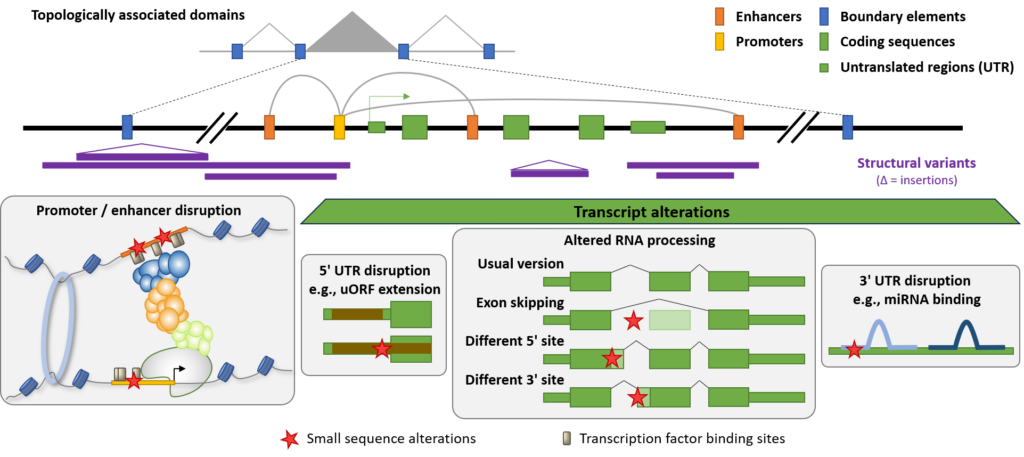
First, exome sequencing (reading the parts of our genome that are transcribed from DNA to RNA) is, by design, blind to the other 98% of the genome – the vast non-protein-coding portion that includes gene regulators such as enhancers and promoters, diverse RNA species, and elements that organise the three-dimensional (3D) folding of chromosomes (Moustakli et al., 2025). The below figure illustrates some of the non-coding mechanisms and how they interact with protein coding sequences in our genomes. As the previous section explained, sex determination is highly sensitive to dosage; a small change in a regulatory switch, rather than in the protein-coding gene itself, can be enough to redirect gonadal fate.