Katharina Dörner is a PhD candidate holding an MD scholarship of CRC 1665, sharing her personal perspective on this year’s EMBO/EMBL Symposium in Heidelberg.
What do fly-intestines, artificial blood vessels, and X-chromosome inactivation have in common?
That’s right, sex differences!
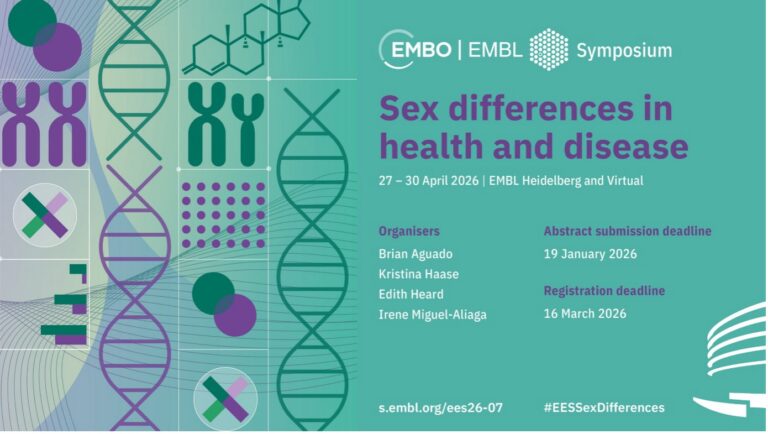
These and many other topics were discussed at the 2026 EMBO/EMBL (European Molecular Biology Organization/ European Molecular Biology Laboratory) Symposium “Sex Differences in Health and Disease” in Heidelberg, Germany. CRC 1665 researchers Nadine Hornig, Prathiksha Ramesh, and I, Katharina Dörner, attended four days full of talks, discussions, and fun group activities at the EMBL Advanced Training Centre. The symposium focused on the following key topics:
- Development and evolution of sex differences
- Sex differences in organ function and physiology
- Plasticity of sex differences, gene-environment interactions, and ageing
- Sex differences in immunity and autoimmunity
- Differences in disease susceptibility, progression, and treatment response systems and engineering approaches to sex differences
A broad range of experimental approaches and methodologies was presented during the symposium, featuring traditional animal models (four core mouse models, Drosophila fly models, C. elegans worm models etc.) and new, innovative models (organoids, biomaterials, 3D cultures, advanced bioinformatics analysis). Here’s a little glimpse into our research group’s trip:
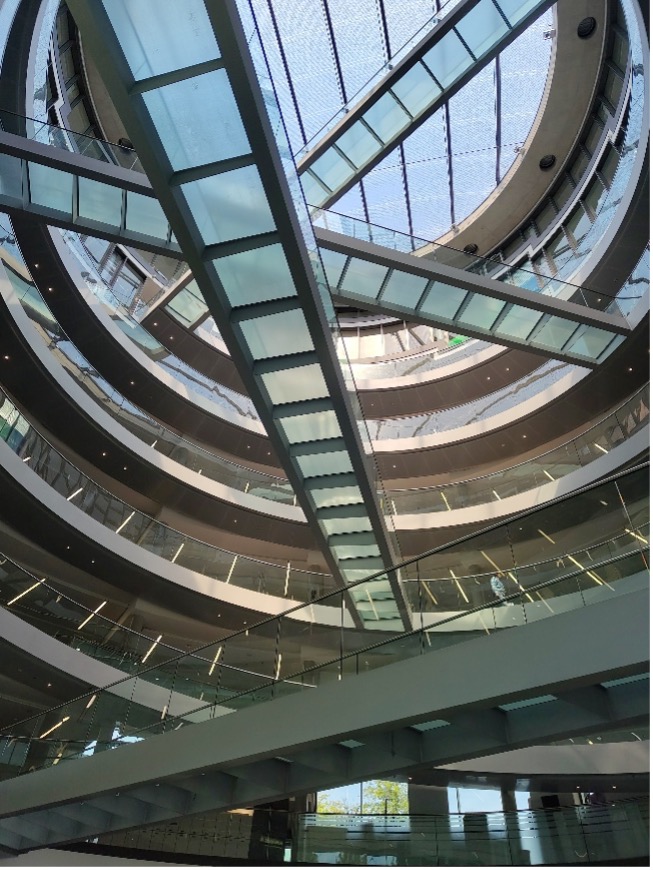
After a long day of travel from Kiel to Heidelberg and a good night’s rest, we took the bus to the Advanced Training Centre which led us up a hill and through twisting forest roads until we finally arrived at the double helix. – The double helix is both the building’s name and a description of its architecture, with glass bridges connecting different “strands” of the spiral tower.
 D
D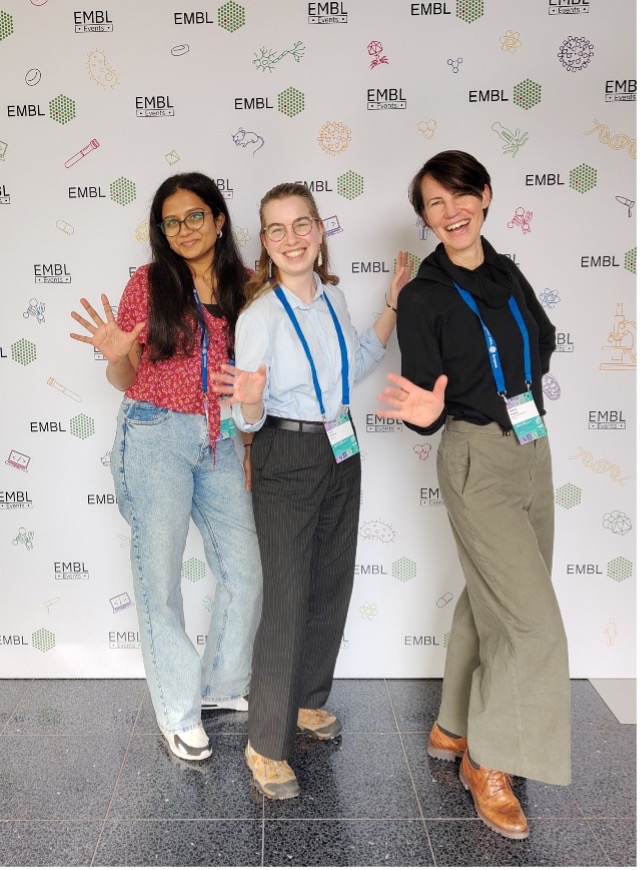
Up: View of the double helix and it’s “hydrogen-bridges”. Down: The attendees from the CRC 1665 (left to right), Prathiksha Ramesh, Katharina Dörner, and Nadine Hornig. Copyright: Katharina Dörner.
The symposium was opened with an airplane safety instruction-style video, informing us about what’s to come. 106 participants attended on site, with 61 joining online, and 66 posters were presented.
The first talk was held by Art Arnold, UCLA, with the title “Asexual theory of sexual differentiation”. He kicked off the conference with the questions and considerations that would continue throughout the next days. What inherent factors does each sex have that makes it different from the other? What is more important to explain sex differences – hormones or chromosomes? Which role does X-inactivation play in sex differentiation and differences? Giving these questions a definitive answer is, if even possible, quite difficult. However, the presentations and discussions sparked inspiration and ideas for how we could get a little closer to answering them.
The symposium was very well-structured, providing lots of opportunities to ask questions, engage in discussions, and connect with fellow scientists. Every few talks, there were coffee breaks where one could meet the speakers and/or take a rest to process all the new information. Overall, the food, drinks, and program were very well organized, making the symposium not only a very informative and inspiring but also fun and enjoyable event.
On the first day, there was a poster sneak peak, allowing the attendees to get a quick look at the posters that were going to be presented in the next days. Scaling the double helix and crossing the (hydrogen-)bridges connecting the strands made of glass and steel, we were able to get a look at the many intriguing and thoughtfully designed posters, as well as the many interesting people attending the symposium.
During the actual poster presentations on day two and three, we were able to talk to very passionate young scientists and learn a lot about what the ‘hot topics’ of biomedical sex research currently are. Some of the most discussed topics were X-chromosome inactivation and Xist (a gene that regulates said inactivation), sex differences in cardio- and neurovascular disease, and new models for investigating biomolecular processes (for example: artificial cell structures). It was impressive to see that people from all over the world came together for this symposium, united by their passion and interest for sex differences and research. There were attendees from Australia, Belgium, Canada, China, Finland, France, Germany, India, Italy, Israel, Japan, Spain, Switzerland, the UK, the US, and many more Countries.
Two talks that particularly stood out to our research group were “The evolution of pregnancy: uncovering the origins of sex‑specific innovations in vertebrates” held by Margarida Cardoso-Moreira, The Francis Crick Institute, and “Escape from X inactivation is directly modulated by Xist noncoding RNA” held by Agnese Loda, Institut Imagine/Institut Pasteur. The first talk covered how sex differences are fast developing, and that the placenta itself is a very interesting organ in terms of its evolution. Margarida Cardoso-Moreira explained that it is a tissue which basically progressed from scratch and, more interestingly, evolved independently over 100 times across species. In her research, she discovered a new type of cells in fish (Poeciliidae) that evolved from granulosa cells and enables the fish to be live-bearers.
The second talk focused on how Xist (a long non-coding RNA that modulates X-chromosome inactivation) concentrations directly influence X-chromosome inactivation. A higher dosage of Xist correlates with the increased silencing of X-inactivation escapees (genes that remain active on largely inactivated chromosomes). Agnese Loda explained how natural fluctuations of Xist impact X-linked protein dosages in individuals with an inactivated X-chromosome. Xist potentially regulates X-linked gene dosages throughout life.
On the last evening, we attended the closing-party on the rooftop of the helix. While listening to the live band The Blackout, we had lots of fun socializing with the other attendees, enjoying the view over Heidelberg and dancing to covers of a great selection of party hits.

Image: The view from the top of the double helix left us in awe and provided a great ending to this exciting symposium.
It was quite interesting to attend this conference and get a look into the biomedical world of sex-related research, since some of the approaches to sex were somewhat different to what we were used to from the CRC 1665 and its iRTG.
What do I mean by that? While within the CRC and its graduate school iRTG the focus often lies on defying strictly binary categories of sex and finding more commonalities than differences, here it seemed to be the other way around. Many of the talks focused on what makes the sexes different, as the headline of the symposium suggests. However, while some of the talks seemed to represent a very binary view of sex at the first glance, it very quickly became clear that there was a general understanding that sex can be many things but is never strictly binary.
As someone who is used to discuss the determinants, meanings, and implications of sex and gender from both a sociocultural and biomedical perspective in the iRTG, it was very inspiring to see how biomedical researchers approach the topic. Although the headline suggested a focus on health and disease, the talks were less clinical than expected. On one hand, it was unusual for me as a medical student to learn so much about biomedical techniques and mechanisms of fundamental research and less about the clinical manifestations. On the other hand, my project isn’t clinical but rather basic research, so it was very inspiring to see what the “grown-up” scientists can achieve in this field.
All in all, this symposium showed us that there are many ways to go about discovering the broad world of biological mechanisms of sex and that there are many kind, intelligent, and passionate people working towards a broader and more complete understanding of it.
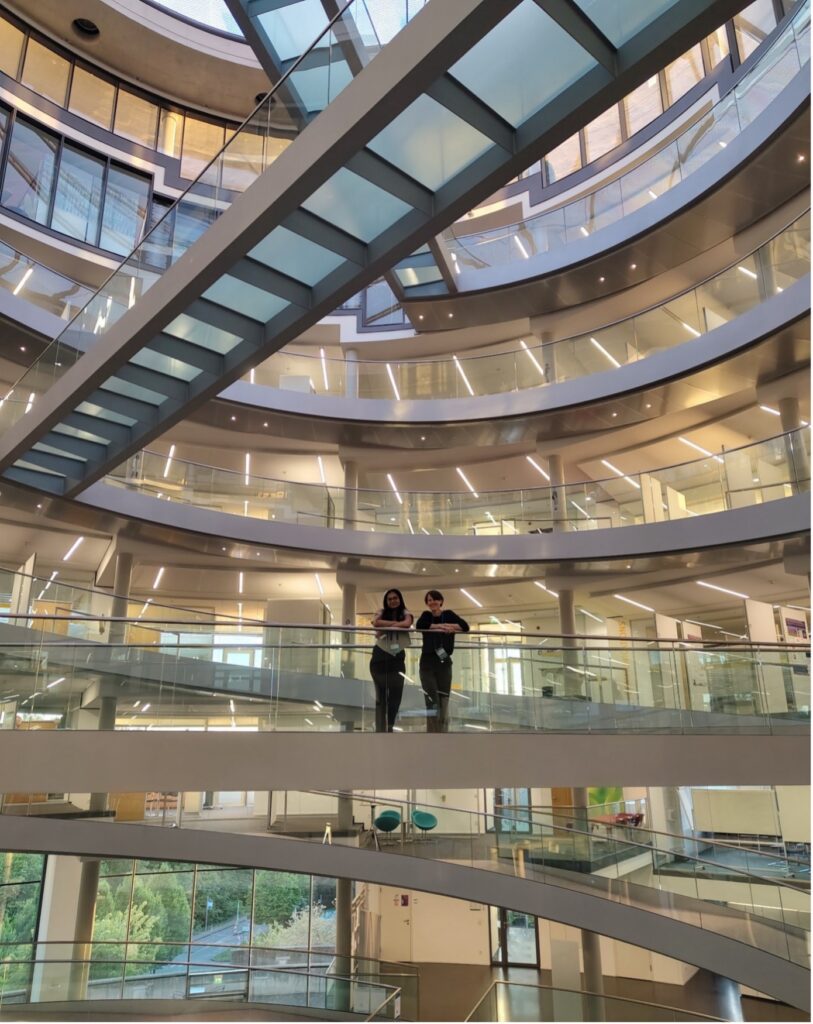
Image: Goodbye from the double helix!
Katharina Dörner
Copyright Images: Katharina Dörner, EMBO Heidelberg