The Distinguished Lecturer Series (DLS) brings together young researchers with internationally renowned experts, ideas and key terms in the multidisciplinary research of sex diversity. This October, we were pleased to welcome Professor Daphna Joel from Tel Aviv University as our guest. The event opened with a public lecture titled “Rethinking Sex, Brain, and Gender: From Binary to Mosaic,” held at the Center for Brain, Behavior and Metabolism (CBBM).
The lecture introduced central concepts in sex-based brain research and gendered neuroscience, with a focus on rethinking traditional binary models of the brain. Through vivid examples and data-driven insights, Professor Joel explored how unsupervised algorithms, anomaly detection, and brain architecture analyses can be used to challenge conventional perspectives and offer alternative interpretations of brain clustering methods. Participants were encouraged to reflect on how categories such as male and female are stereotypically constructed, applied, and questioned within both scientific and social frameworks.
Key Insights: Beyond Binary Thinking in Brain Structure and Sex-Related Factors
Sex-related variables influence brain structure, but their effects are deeply intertwined with other biological and environmental factors. Each brain is unique in weight, structure, and regional grey matter distribution differs individually, forming a continuum rather than a dichotomy. Sex category provides limited predictive value for brain structure; instead, unsupervised clustering approaches reveal patterns that cut across binary boundaries.
These insights prompted thought-provoking questions such as: If sex categories tell us little about brain structure, what alternative frameworks should neuroscience adopt to describe diversity? How can interdisciplinary approaches – combining data science, endocrinology, and sociology – help us move beyond the myth of the “male” versus “female” brain?
During her talk, Professor Daphna Joel discussed how brain-imaging research has revealed that thousands of neural connections link and coordinate communication within and across the brain’s hemispheres. This complex network demonstrates how different parts of the brain interact both within each hemisphere and across the two sides, emphasizing the brain’s highly integrated nature. In 2024, she examined how oxytocin and vasopressin bind to specific receptors in the brain that influence social behavior, stress responses and bonding (Joel 2024). Joel emphasized the role of dendritic spines, which are tiny protrusions on neurons that facilitate the transmission of signals between brain cells. Research on rats has shown that stress, supplements, and housing environment can all affect dendritic spine density. Illustrating that the brain is not fixed but built to change. This biological plasticity reinforces her central argument that the brain is flexible and continuously shaped by dynamic hormonal levels, environmental influences and social contexts.
The lecture concluded with an engaging discussion emphasizing how sex categories remain socially significant, particularly in the context of reproduction and cultural identity, but have limited explanatory power in neuroscience. The audience left with a sense of how interdisciplinary collaboration, persistence in peer review, and feminist scientific perspectives can reshape the way we study and talk about the brain.

PhD Seminar Highlights: Exploring Brain Diversity in Group Discussion
On Friday, 17th October 2025, the seminar continued at the Institute for History of Medicine and Science Studies (IMGWF). Participants gathered at 9:00 for a half-day session designed to foster collaborative learning and deeper engagement with the themes introduced in the lecture.
The morning began with a short introduction, followed by a discussion on unsupervised data analysis – a method that identifies hidden patterns without relying on predefined categories such as “male” or “female.” Professor Joel explained how such analyses in 2018 revealed ten main brain architecture clusters and smaller subclusters, some associated with rare structural configurations and neurodevelopmental conditions like autism (Joel 2018). These findings further underscored that sex-based labels cannot predict brain organization and that focusing on cluster-based brain typologies may better capture neurobiological diversity.
At the heart of the seminar was group work based on the article from The Scholar & Feminist Online, “Eight Things You Need to Know About Sex, Gender, Brains, and Behavior”.
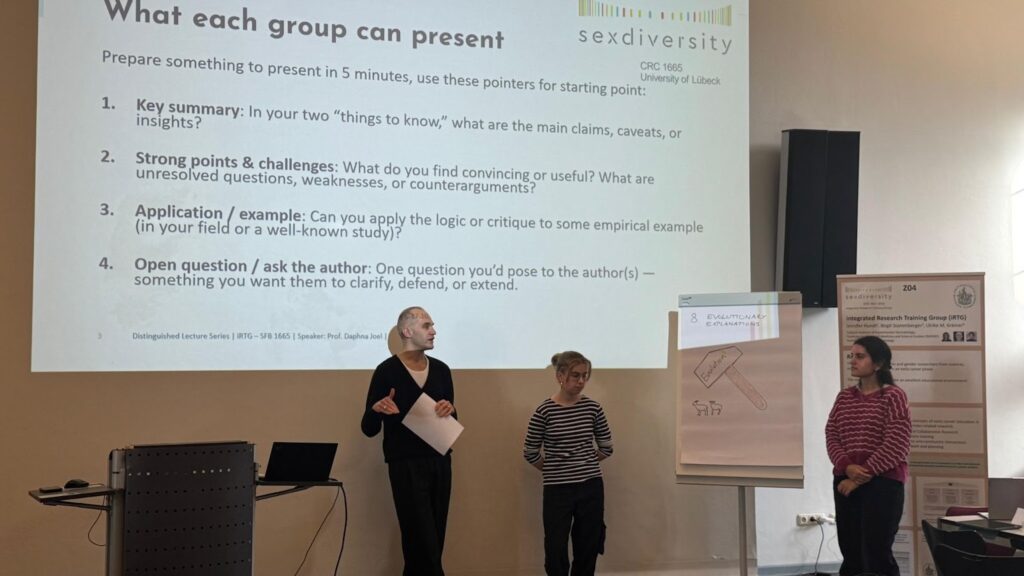
Participants divided into four groups, each exploring two of the article’s eight themes. Guided discussions revolved around theoretical assumptions, methodological biases, and the broader implications of moving beyond binary frameworks in research. One recurring theme was the gender-binary cycle–how it remains central to human culture despite growing evidence for a gender mosaic, a dynamic interplay between hormones, self-perception, communication, and social experience at the intrapersonal level.
After group discussions, each team presented their reflections, highlighting tensions between scientific classification and social meaning. The subsequent Q&A with Professor Joel touched on publishing challenges, the role of feminist collaborations, and the resistance faced by researchers questioning traditional paradigms.

Midway through the seminar, participants enjoyed a relaxed brunch buffet, during which many took part in the Gender Mosaic Questionnaire. This sparked spontaneous conversations about how hormonal distributions overlap between sexes, how estradiol and progesterone levels vary dynamically, and how political and cultural systems shape gender expectations worldwide.

The session concluded with collective reflections emphasizing the value of interdisciplinary dialogue, critical self-reflection, and collaborative analysis. Many attendees expressed appreciation for the space to interrogate how sex and gender categories operate within their own research and to imagine more nuanced approaches for future studies.
We thank Professor Daphna Joel for her time, openness, and thought-provoking engagement, and extend our gratitude to all participants for their enthusiastic contributions. This DLS event once again demonstrated how bringing together critical thinking, feminist perspectives, and scientific inquiry creates space for meaningful dialogue – a core goal of CRC 1665.
Lea Egli & Ali Hassan
Literature:
Joel D, Smith CJ, Veenema AH. Beyond the binary: Characterizing the relationships between sex and neuropeptide receptor binding density measures in the rat brain. Horm Behav. 2024 Mar;159:105471. doi: 10.1016/j.yhbeh.2023.105471. Epub 2023 Dec 21. PMID: 38128247; PMCID: PMC11624905.
Joel D, Persico A, Salhov M, Berman Z, Oligschläger S, Meilijson I and Averbuch A (2018) Analysis of Human Brain Structure Reveals that the Brain “Types” Typical of Males Are Also Typical of Females, and Vice Versa. Front. Hum. Neurosci. 12:399. doi: 10.3389/fnhum.2018.00399