Invitation to the next Distinguished Lecture Series 12. December 2024: Sex and Gender in the History of the Life Sciences

Linné-Praeludia_Sponsaliorum_Plantarum

The iRTG of the Collaborative Research Center (CRC) 1665 “Sexdiversity” would like to invite you to the upcoming public lecture of the Distinguished Lecture Series (DLS) on Thursday, 12. December 2024, at 4 p.m. (until 6 p.m.).

Professor Staffan Müller-Wille (Cambridge) will give a talk on 

Sex and Gender in the History of the Life Sciences

Abstract: 

Science, technology and medicine are often portrayed as driving forces in the formulation and reinforcement of sex binaries and gender stereotypes based on these. At the same time, recent decades have seen a burgeoning literature on how life scientists, in the past and in the present, have been revealing queer patterns in the formation and variation of sex across all life forms. In this talk, I am going to review the history of understandings of sex and gender from antiquity to the mid-twentieth century. My argument will be that sex, and consequently gender, were always held as fluid categories allowing for endless variations and permutations. It is precisely because of that, however, that they always have been subject to normalizing discourses. Sex variation had to be reigned in, paradoxically, precisely because it seemed normal but not in line with prevailing or aspired norms. 

Staffan Müller-Wille is Professor in History and Philosophy of the Life Sciences at the University of Cambridge and holds an Honorary Chair at the University of Lübeck. His research covers the history of the life sciences from the early modern period to the early twentieth century, with a focus on the history of natural history, anthropology, and genetics. Among his publications is a book co-authored with Hans-Jörg Rheinberger on The Cultural History of Heredity(2012) and further co-edited collections on Human Heredity in the Twentieth Century (2013), Heredity Explored: Between Public Domain and Experimental Science, 1850–1930 (2016), The Gene in the Postgenomic Era, co-authored with Hans-Jörg Rheinberger (2017), In the Shadow of the Tree: The Diagrammatics of Relatedness in Genealogy, Anthropology, and Genetics as Epistemic, Cultural, and Political Practice, co–authored with Marianne Sommer, Caroline Arni and Simon Teuscher (2024).

The DLS will take place in the IMGWF Lecture Hall Königstr. 42, 23552 Lübeck and online as a Webinar via Webex. More information here.

Teilen:

Mehr Posts

Why does Parkinson’s Disease affect men more often?  DLS Recap on Sex Differences in Astrocytes and Oligodendrocytes

The first day featured a lecture by Julia M. Schulze-Hentrich, Professor of Genetics and Epigenetics at Saarland University. Alongside our CRC1665 group, colleagues from neurogenetics also joined the presentation, adding welcome expertise to the room. The paper “Sex and Gender Differences in the Molecular Etiology of Parkinson’s Disease”, which she co-authored, had been shared with the doctoral students beforehand, and to make it accessible across disciplines we also prepared a glossary of key terms.

IOC und Geschlechtstests im Sport: Fairness oder Ausgrenzung?

Im März 2026 hat das internationale olympische Komitee (IOC) neue Richtlinien für die Frauenkategorie im olympischen Sport verabschiedet. Grundlage dafür war eine umfassende Policy zum Schutz der Frauenkategorie im Sport im März 2026, in die wissenschaftliche, medizinische, rechtliche und ethische Erkenntnisse sowie Rückmeldungen von Athlet*innen eingeflossen sind.

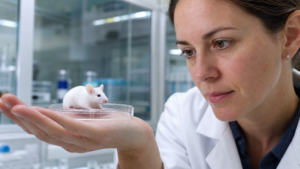
Von Zellen, Mäusen und Menschen

Was können wir in der Hormonforschung aus Modellsystemen lernen? Und welchen Zusammenhang gibt es zwischen Geschlecht, Körpertemperatur und Herzschlag?
Dieser Blogbeitrag eröffnet einen Blick hinter die Kulissen der endokrinologischen Forschung. Er geht der Frage nach, wie Wissenschaftler*innen die chemischen Botenstoffe des menschlichen Körpers untersuchen können. Wie werden dabei Tier- und Zellmodelle eingesetzt? Und warum sind die von uns verwendeten Werkzeuge entscheidend?

Nach oben scrollen